AI checker scores: false positives and careful interpretation
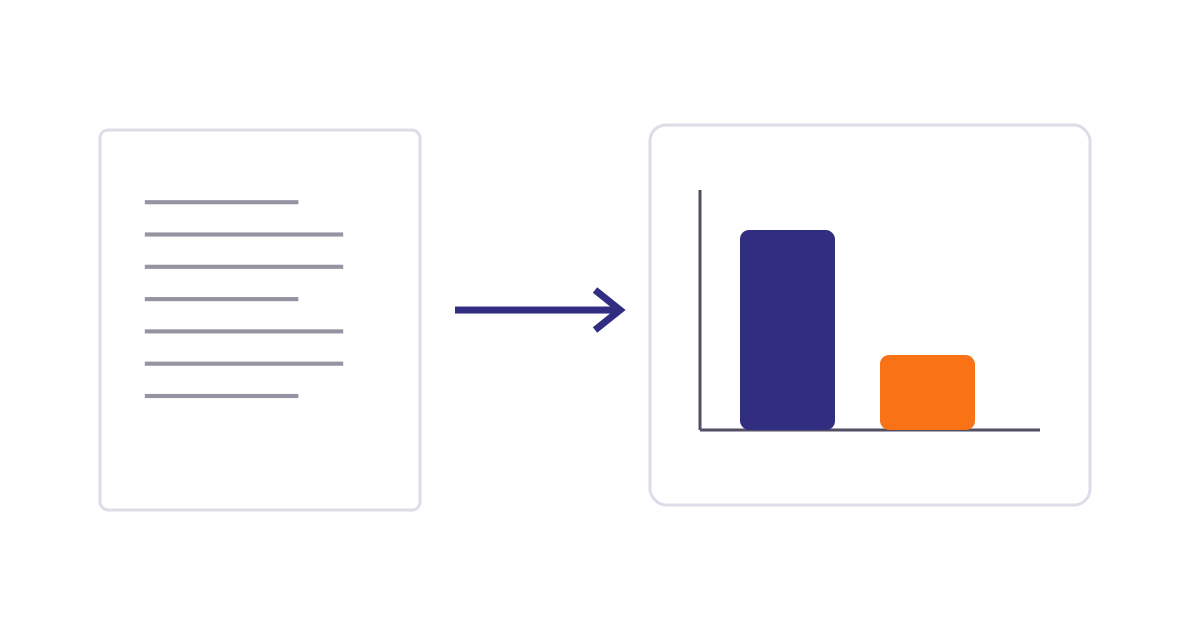
Seeing 71% on an AI checker can feel like a measured share of machine-written sentences. The model has not counted those sentences. I read the label and the method used to combine window scores before deciding what the number tells me.
The main Check text button reports style patterns calculated with fixed rules. For the classifier outputs discussed here, choose Deep check with AI model. Keep that method name beside the score: the two checks answer different questions, and their percentages are not interchangeable.
A classifier score answers a narrow question
The model receives tokenized text and produces two numerical outputs associated with its human and ai classes. The interface converts those outputs into a two-class softmax score. That score describes the model’s relative output for this input. It is not a record of the writing process, and it does not reveal which person typed, edited or approved the passage.
Training a classifier to separate example classes is different from calibrating its outputs as real-world probabilities. To justify a claim such as “there is a 71% chance this author used AI,” you would need evidence about calibration on a relevant population and the conditions of the actual case. This interface makes no such claim. Numerical precision should not substitute for that missing evidence.
Read the percentage scale correctly
The display multiplies the fractional score by 100. A score of 0.71 therefore appears as 71%. Multiplication changes the presentation, not the meaning. The result does not say that seven out of ten words came from an AI system, or that seven out of ten readers would identify the text as generated. It also does not locate a specific generated sentence.
A rounded display can conceal small differences between checks. CSV exports preserve the raw fractions, while the visible card uses a readable localized number. Do not treat a change from 70.9% to 71.1% as meaningful evidence about a writer’s behavior. The classifier can respond to a revised phrase or a different context without the author’s actual workflow having changed.
| Report item | Valid reading | Unsupported conclusion |
|---|---|---|
| AI-class score | The classifier’s output for a window | The author used a particular AI service |
| Token-weighted mean | A summary weighted by window length | The fraction of AI-written words |
| High or low result | A screening observation | Proof of misconduct or proof of human authorship |
| Complete token coverage | No accepted tokens were skipped | Every meaning and context was understood |
Keep both directions of error in mind
A false positive occurs when a human-written passage is treated as generated. A false negative occurs when generated material escapes that classification. Either can matter, and this tool does not claim to have eliminated either. Formal language, unusual subject matter, an edited passage or a style unlike the training material can complicate interpretation. A model’s familiarity with a pattern is not evidence about a specific person.
I would not ask a writer to make their prose less clear simply to lower a detector score. Changing ordinary transitions or adding accidental errors can alter the output without making a document more accurate or more honest. Write for your audience, meet your publication’s requirements, and keep an appropriate record of the process when that record is needed. A detector should not become an arbitrary style target.
Understand a document with several windows
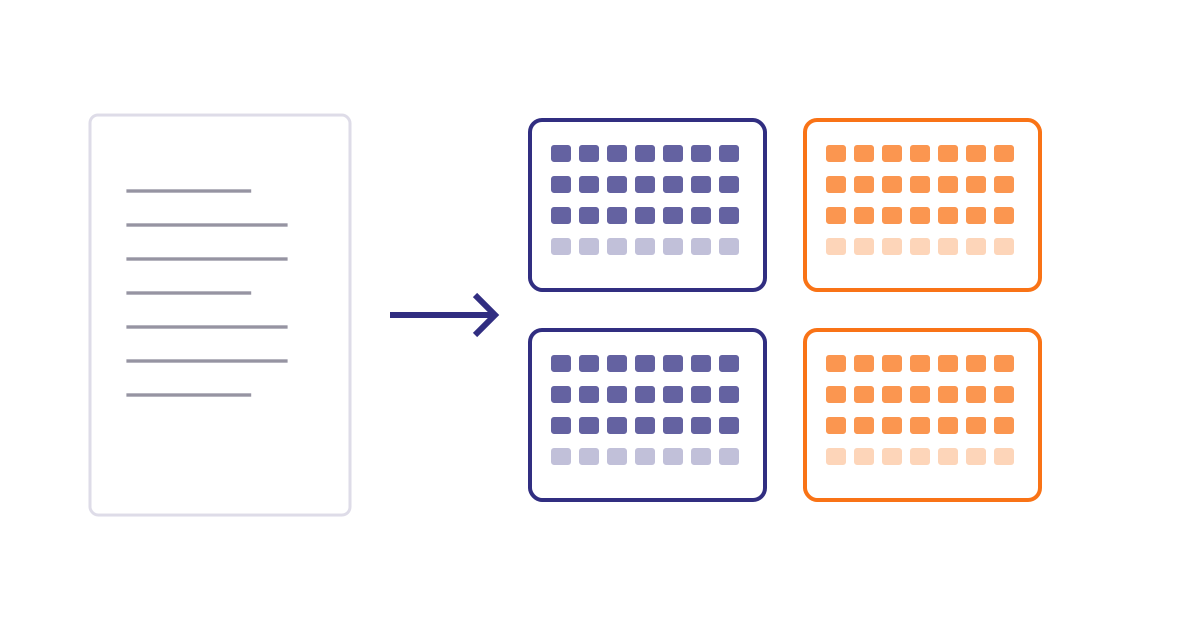
This AI checker processes up to four non-overlapping windows of 510 content tokens. Each window has its own model inference. The large card is a token-weighted mean, a reporting choice made by this interface. It does not ask the model to read all four windows as one continuous context. Information at the end of one window is not carried across the boundary into the next.
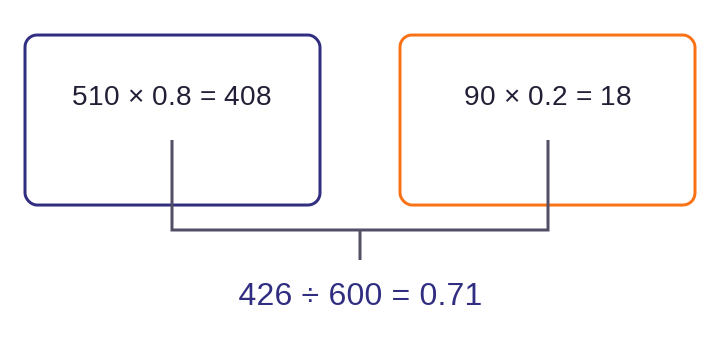
The synthetic control case has 510 tokens at score 0.8 and 90 tokens at score 0.2. Multiplying produces 408 and 18; dividing their sum of 426 by 600 gives 0.71. The shorter final section has less influence on the mean. Inspecting the two separate values helps you see that the passage is not receiving one uniform output. It still does not show whether authorship differs between sections.
Do not turn word statistics into a second detector
The repeated-word list is a descriptive aid. A common term may recur because a passage explains a single technical concept. Function words recur because English sentences need them. These observations do not establish that a sentence was generated. The interface deliberately separates locally calculated word statistics from the neural model score instead of presenting repetition as its explanation.
Similarly, a short passage with one sentence provides little information about variation between sentence lengths. Declaring such prose machine-like because a calculated variation is zero would be a mathematical artifact. The tool requires at least 80 words and gives an automatic language warning when English is not recognized. The quick sentence-uniformity feature is zero for fewer than three sentences. These checks improve interpretation without promising correctness for every accepted draft.
Use a result as a prompt for a fair review
For a private writing experiment, record what you checked and compare the result with what you actually know about the draft. For work involving another person, follow the applicable review process and consider original drafts, revision history and explanations. Do not replace those sources with a screenshot of a score. An exported model report should retain its limitation notice and model identifier.
- Confirm that the passage is English prose within the stated limits.
- Read each window range and the total coverage.
- Identify whether the displayed value is a window score or the weighted mean.
- Remember both false positives and false negatives.
- Keep ordinary word statistics separate from authorship claims.
- Use independent contextual evidence before a consequential decision.
The AI checker includes those distinctions in its report. The coverage and processing guide explains why word counts and token limits differ. Consult the model card for the underlying model rather than borrowing an advertised benchmark as a guarantee for your own passage.
Common questions
Does the score measure the share of AI words?
No. It is a model class score, or a weighted mean of those scores.
Can a human draft get a high score?
Yes. False positives are possible; no score proves authorship.
Why show individual windows?
They disclose variation within the processed token sequence and the inputs to the summary.